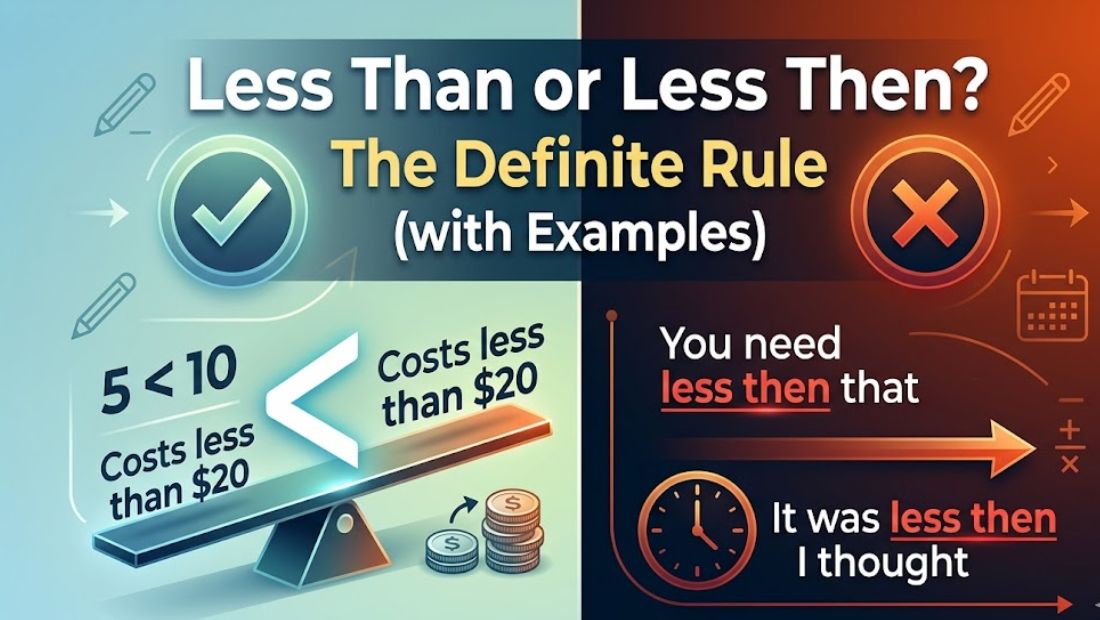

The correct phrase is “less than.” When you are comparing two numbers, amounts, or quantities, “less than” is always the grammatically correct choice. The phrase “less then” is a common spelling mistake and is always incorrect in comparisons because “then” refers to time or sequences, not amounts.
The Quick Rule: Use than for comparison (e.g., five is less than ten). Use then for time (e.g., we ate, then we left).
Quick Comparison: Than vs. Then
To easily understand why “less than” is correct, look at the fundamental difference between the two words:
| Word | Function | Sentence Example |
| Than | Conjunction used for comparison | A dime is worth less than a quarter. |
| Then | Adverb used to indicate time or sequence | Finish your work, then you can go play. |
When to Use “Less Than” (With Examples)
You should use “less than” whenever you are stating that one measurement, number, or concept is smaller or fewer than another.
- Comparing Numbers: $5$ is less than $10$.
- Comparing Time: The drive took less than an hour.
- Comparing Money: The shirt cost less than $20.
- Comparing Quantities: There is less than half a gallon of milk left.
The Math Connection
In mathematics, the “less than” relationship is so foundational that it has its own universal symbol: $<$.
- For example, the statement $x$ is less than $y$ is written as:
$$x < y$$
Why “Less Then” Is Always Grammatically Incorrect
People frequently type “less then” by accident because than and then sound nearly identical in casual speech (homophones). However, using “less then” breaks the rules of English grammar.
Because “then” means “at that time” or “next,” putting it after “less” creates a phrase that literally means “less at that time,” which makes no sense in a comparison.
- Incorrect: I have less then three days left.
- Correct: I have less than three days left.
Note: The only time “less” and “then” ever appear next to each other legally is if a comma separates them as part of a sequence:
“If you want to spend less, then you need a strict budget.”
Comprable vs Comparable Understanding Common English
Indulgent vs Sober: Understanding Meaning, Usage
Data Proof: Which Phrase is Used More?
According to historical data from the Google Books Ngram Viewer—which tracks millions of printed books over centuries—“less than” dominates written English.
“Less then” barely registers on linguistic charts because it is universally recognized by editors and algorithms as a typo.
Frequently Asked Questions
What is the correct phrase, “less then” or “less than”?
The correct phrase is “less than.” It is used to compare quantities, numbers, or sizes to show that one is smaller than the other. “Less then” is incorrect.
Can you use “less then” in informal text messages?
No. While people may understand what you mean in a casual text message, “less then” remains grammatically incorrect. To maintain clear communication, always use “less than.”
How do you remember the difference between than and then?
A simple memory trick is to look at the letters inside the words:
- Than contains the letter A, just like the word Amounts (used for comparison).
- Then contains the letter E, just like the word Time (used for sequence).
