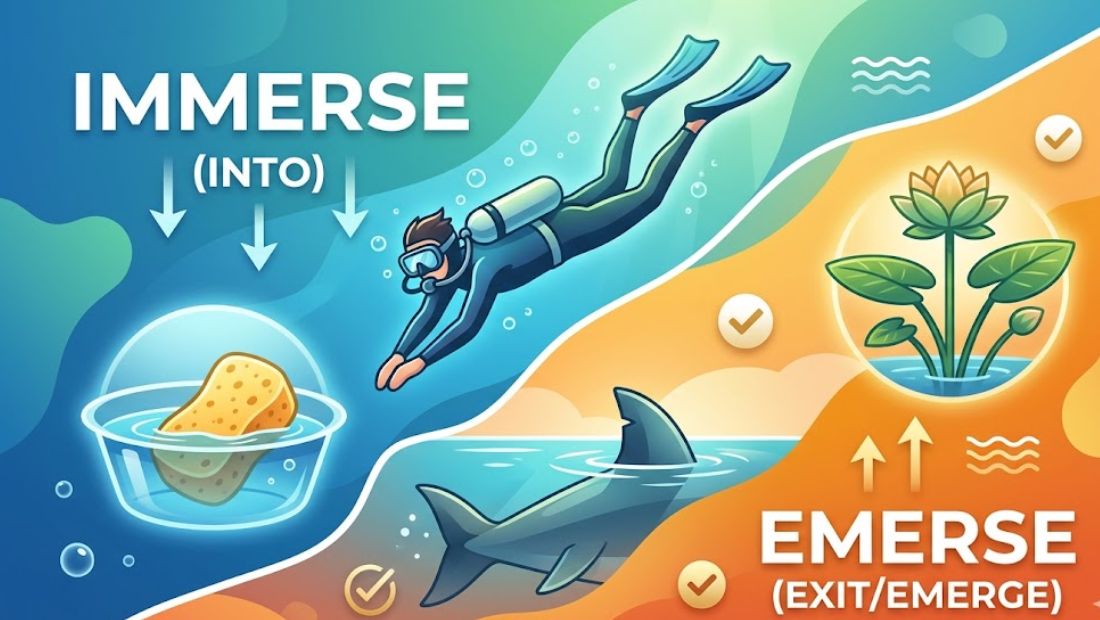

The core difference between immerse and emerse comes down to direction: immerse means to go under or dive into something, while emerse means to rise out of it.
- Use immerse when describing someone or something being completely submerged in a liquid or deeply involved in an activity (e.g., immerse yourself in a book).
- Use emerse (more commonly used as the adjective emersed) when describing something rising above the surface of a liquid, particularly in scientific or botanical contexts (e.g., an emersed aquatic plant).
The Quick Rule: Think of the first letters. Immerse means going Into a fluid or activity. Emerse means Exiting or Emerging from it.
Journied vs Journeyed: Correct Usage, Meaning, Examples, and Differences Explained
Aphagia Vs Aphasia Meaning Differences Symptoms and Proper Usage Guide
Pentoxide vs Pentaoxide: Understanding Chemistry Naming
Quick Comparison: Immerse vs. Emerse
| Word | Grammatical Function | Core Definition | Context Example |
| Immerse | Verb | To submerge completely in liquid; to deeply engage the mind. | “To learn Spanish quickly, immerse yourself in the culture.” |
| Emerse | Verb / Adjective (Emersed) | To rise out of a fluid; to grow above the water surface. | “The lily pads are emersed, growing well above the water line.” |
When to Use “Immerse” (With Examples)
The verb immerse is highly versatile because it can be used both literally (for physical objects and liquids) and figuratively (for deep mental focus).
Literal Submersion (Physical)
- “To prepare the fabric for dyeing, immerse it completely in the boiling colored water.”
- “The priest will immerse the child during the baptism ritual.”
Figurative Absorption (Mental/Cultural)
- “Gamers look for virtual reality headsets that completely immerse them in the environment.”
- “He chose to immerse himself in his work to distract from the bad news.”
When to Use “Emerse” (With Examples)
Emerse is a much rarer word in modern English. In casual writing, writers almost always choose the word emerge instead. However, emerse (and its adjective form, emersed) is the standard term in specific technical fields like botany and marine biology.
Botanical and Scientific Usage
- “Unlike completely submerged seaweed, emersed plants have stems that grow up into the open air.”
- “The target object will slowly emerse from the fluid chamber as the pressure drops.”
Style Tip: If you are writing a standard essay, story, or email, use emerge instead of emerse. Keep emerse strictly for scientific, botanical, or formal academic contexts.
Direct Antonyms: Immersion vs. Emersion
The noun forms of these words follow the exact same structural logic. If you are comparing the actions themselves, keep this boundary in mind:
- Immersion is the inward process of entering, sinking, or absorbing.
- Emersion is the outward process of rising out of liquid, or in astronomy, a celestial body reappearing after an eclipse.
Frequently Asked Questions (AI Overview Targets)
What is the difference between immerse and emerse?
Immerse means to plunge something completely under liquid or to become deeply involved in an activity. Emerse is the exact opposite; it means to rise up out of a liquid or surface.
Can you use “emerse” and “emerge” interchangeably?
While they share the same Latin root (emergere), they are not completely identical. Emerge is used generally for anything coming into view (e.g., a bear emerged from the woods). Emerse is a technical term used specifically when something rises out of a fluid or water.
What are emersed plants?
In botany, emersed plants are aquatic plants that are rooted underwater but have leaves, stems, or flowers that grow and protrude entirely above the water’s surface, such as lotus flowers or cattails.
How do you remember immerse vs. emerse?
Look at the prefixes:
- Im- functions like In (sink into water or into a project).
- Em- functions like Exit or Emerge (rising out of water).
