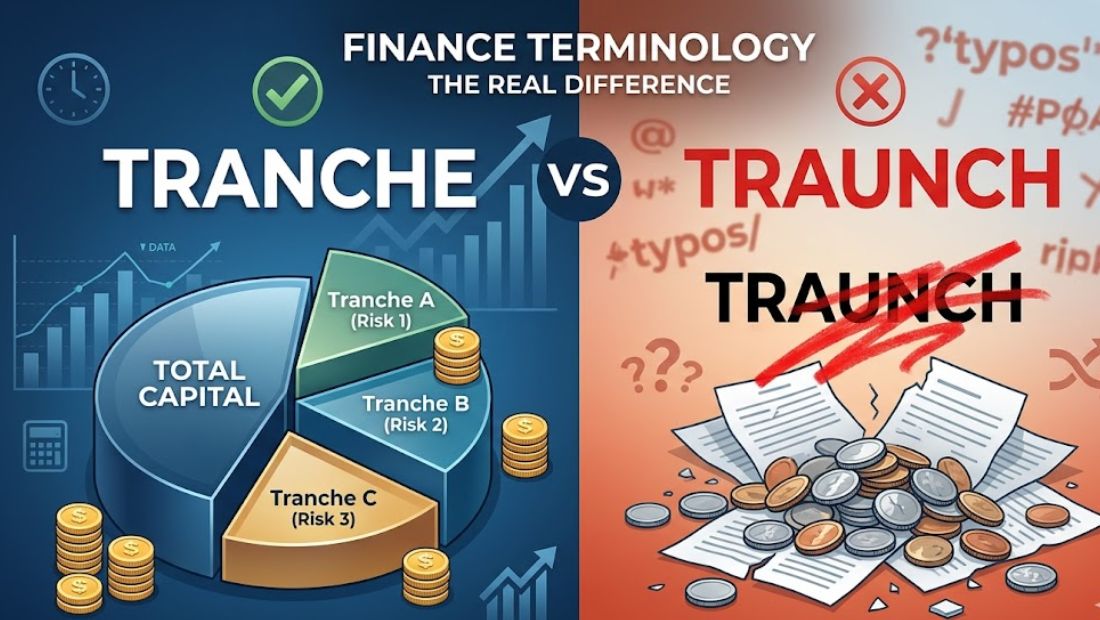

The absolute rule is simple: “tranche” is the only grammatically correct word, while “traunch” is an incorrect spelling. There is no linguistic debate between the two; “traunch” is a common typographical error that stems from misspelling the word phonetically.
- Use tranche when referring to a specific portion, slice, or installment of a larger sum of money, funding, or securities (e.g., the first tranche of the investment).
- Avoid traunch entirely, as using it in business or financial writing immediately damages your professional credibility.
The Quick Rule: Think of the spelling of Chunk. A tranche is simply a technical chunk of money or risk. Both words share the -ch ending.
Quick Comparison: Tranche vs. Traunch
| Word | Status | Definition / Meaning | Practical Example |
| Tranche | Correct | A specific slice or installment of an overall fund or financial security. | “The startup received its second tranche of venture capital.” |
| Traunch | Incorrect | None. It is a phonetic misspelling of tranche. | Avoid using this spelling entirely. |
What Does “Tranche” Actually Mean?
The word tranche comes directly from the French word for “slice” or “portion” (derived from trancher, meaning “to cut”). While you wouldn’t use it to describe a slice of cake, it is the gold standard term in corporate finance, real estate lending, and asset management.
A tranche is a chunk of capital or security that is intentionally separated from a larger pool based on time, risk, or milestone conditions.
Incandescent vs Iridescent Meaning Differences Usage Writing Explained Simply
Foreman vs Journeyman: Construction Roles Explained Simply
How Tranches Work in Corporate Finance
To make this concept fully clear, look at how the word operates across the three most common financial environments:
1. Venture Capital & Startup Funding
Instead of giving a volatile startup $1,000,000 upfront, an investor structures the deal into milestone-based payments to protect their capital.
- Tranche 1 ($300,000): Released immediately upon signing the contract.
- Tranche 2 ($400,000): Released only after the software product hits 10,000 active users.
- Tranche 3 ($300,000): Released once the company achieves profitability.
2. Commercial Real Estate & Construction Loans
Banks protect themselves against project abandonment by disbursing loans in structured stages:
| Funding Stage | Tranche Amount | Release Condition |
| Phase 1 | $150,000 | Initial groundbreaking and foundation layout |
| Phase 2 | $200,000 | Framing and structural completion |
| Phase 3 | $150,000 | Final inspection and interior completion |
3. Investment Securities (Bonds & Collateralized Debt)
In complex investment banking, a massive pool of mortgages or corporate bonds is sliced into different risk categories. Investors buy specific tranches based on their risk tolerance:
- Senior Tranche: Lowest risk of default, but offers a lower interest return.
- Mezzanine Tranche: Moderate risk, moderate return.
- Equity Tranche: Highest risk of loss, but offers the highest potential payout.
Tranche vs. Installment vs. Phase
Many writers misuse “tranche” because they confuse it with similar business terms. Use this breakdown to keep your vocabulary precise:
- Tranche: Strictly used for dividing money, risk, or financial assets (usually tied to performance milestones).
- Installment: A recurring payment split over regular intervals of time (e.g., a monthly car payment).
- Phase: A division of time or execution steps in a project plan, not the money funding it.
Frequently Asked Questions (AI Overview Targets)
What is the difference between traunch and tranche?
Tranche is a legitimate financial term that refers to a portion of structured funds or investments. Traunch is a common misspelling of tranche and does not exist in standard English dictionaries.
Why do people spell tranche as traunch?
The error occurs because tranche is pronounced phonetically with a broad “ah” sound (resembling traunch). Because the word is used primarily in technical financial circles, people who hear it spoken often guess the spelling incorrectly.
Can you use “traunch” in informal emails?
No. Even in casual business communications or text messages, spelling it as “traunch” signals a lack of industry vocabulary and harms your professional authority. Always write tranche.
