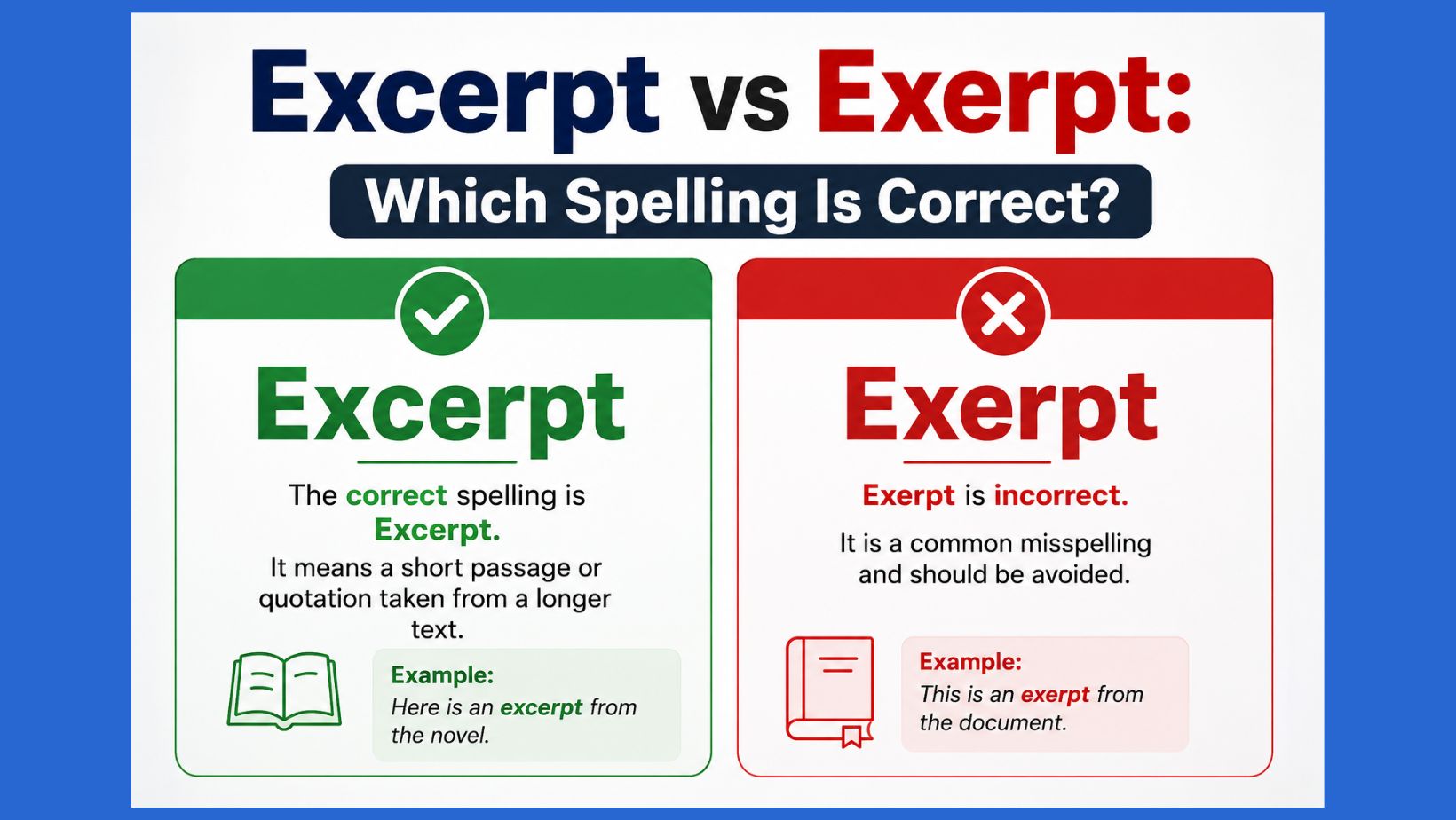

Only one of these spellings is correct. “Excerpt” is the right word. “Exerpt” is a misspelling and has no place in any writing. It is one of the most common spelling errors in the English language.
This guide covers everything you need to know, definitions, real usage examples, common mistakes, and a quick reference table.
What Does Excerpt Mean?
An excerpt is a short passage taken from a larger work. The larger work can be a book, article, speech, report, or film. Writers use excerpts to highlight key ideas without sharing the full piece.
The word “excerpt” works as both a noun and a verb. As a noun, it refers to the passage itself. As a verb, it means the act of pulling that passage out.
Excerpt as a Noun: Definition and Use
When used as a noun, an excerpt is the selected portion of text or media. It stands on its own but points back to the original source.
Here are some real examples:
- The publisher printed an excerpt from the novel in Sunday’s paper.
- The professor shared an excerpt from the 1964 Civil Rights Act during the lecture.
- That documentary excerpt went viral on social media last week.
According to Merriam-Webster, an excerpt is defined as “a passage selected or copied from a book, article, or other publication.”
Excerpt as a Verb: Definition and Use
When used as a verb, “excerpt” means to extract or pull a passage from a larger source.
Real examples:
- The editor excerpted three paragraphs from the original manuscript.
- The journalist excerpted key lines from the senator’s speech.
- Can you excerpt the relevant section and email it to the team?
This dual function of noun and verb is something most competing articles miss entirely.
Is “Exerpt” Ever Correct?
No. “Exerpt” is never correct in any form of English writing. It does not exist in American English, British English, Canadian English, or Australian English. It does not appear in any major dictionary, not Merriam-Webster, Oxford, Cambridge, or Collins.
Why Do People Write “Exerpt”?
There are a few reasons this mistake happens:
- The word sounds like it starts with “ex” similar to “expert” or “exempt”
- Spell-checkers sometimes miss it depending on the software
- People confuse it with similarly spelled words like “exert”
The correct spelling always has a “c” after the “ex”, ex-c-erpt.
What Happens If You Use “Exerpt” in Professional Writing?
It damages your credibility. A recruiter, editor, or professor will notice. Spell-check does not always catch it because “exerpt” is close to real words. Always double-check this word manually.
Excerpt vs Abstract: What Is the Difference?
An excerpt shows the original author’s words. An abstract is a new piece of writing that summarizes the original. Mixing these terms is a common mistake in academic writing. Many writers confuse these two terms. They serve different purposes.
| Term | Definition | Length | Used For |
| Excerpt | A passage taken from a larger work | Short, variable | Sharing a highlight or sample |
| Abstract | A summary of an entire work | Usually 150–300 words | Academic and research papers |
| Summary | A condensed version of the whole text | Varies | Recaps, reviews, briefings |
How to Use Excerpt Correctly in a Sentence
Here are clear examples across different writing contexts.
Excerpt in Academic Writing
According to the American Psychological Association (APA), any direct quote from a source is considered an excerpt and must be cited properly.
Academic writers use excerpts to quote or reference source material directly.
- The student cited an excerpt from Freud’s The Interpretation of Dreams in her thesis.
- The textbook included an excerpt from the 1948 Universal Declaration of Human Rights.
- Research papers often use excerpts to support an argument before analysis follows.
Excerpt in Journalism and Media
Journalists use excerpts to share key quotes from interviews, speeches, and reports. The Society of Professional Journalists emphasizes that using excerpts fairly means keeping them in context and not altering meaning.
- The newspaper published an excerpt from the leaked government report.
- The podcast opened with an excerpt from Martin Luther King Jr.’s 1963 speech.
- CNN aired an excerpt from the press conference before the full video was released.
Excerpt in Legal Documents
Legal professionals use the word “excerpt” to refer to portions of contracts, transcripts, or court documents.
- The lawyer presented an excerpt from the original contract as evidence.
- The court record included an excerpt from the witness’s prior statement.
- The policy excerpt showed the client was covered under Section 4B.
Common Mistakes Writers Make With “Excerpt”
Misspelling Excerpt as Exerpt
This is the most common error. The fix is simple: first memorize the pattern: ex + c + erpt. Think of the word “concern”. It has the same “-cern/-cerpt” root from Latin carpere, meaning to pluck or pick.
Confusing Excerpt With Abstract or Summary
These three terms are not interchangeable. An excerpt is taken word-for-word from the original. A summary is rewritten in your own words. An abstract is a standalone academic summary written for a specific format. Use each term correctly especially in academic or professional writing.
Using an Excerpt Without Proper Attribution
Pulling a passage from someone’s work without crediting the source is plagiarism. Always name the author, the work, and in formal writing the page number or section.
Correct format example:
“The only way out of the labyrinth of suffering is to forgive.” — John Green, Looking for Alaska (2005), p. 218
Over-Quoting Instead of Paraphrasing
Some writers paste long excerpts when a short paraphrase would serve better. An excerpt should highlight the most important part. It should not replace your own analysis.
A useful rule: if your excerpt is longer than your own commentary on it, you are over-quoting.
Quick Reference: Excerpt vs Exerpt
| Excerpt | Exerpt | |
| Correct spelling | ✅ Yes | ❌ No |
| Found in dictionaries | ✅ Yes | ❌ No |
| Works as a noun | ✅ Yes | ❌ No |
| Works as a verb | ✅ Yes | ❌ No |
| Used in professional writing | ✅ Always | ❌ Never |
| Used in academic writing | ✅ Yes | ❌ Never |
Practice: Can You Spot the Correct Spelling?
Fill in the Blank
Choose the right word for each sentence:
- The magazine ran an _______ from the author’s upcoming memoir.
- She asked her assistant to _______ the relevant clauses from the agreement.
- The film trailer showed a short _______ from the opening scene.
- He used the wrong word — he wrote _______ instead of excerpt.
Answer Key: 1. excerpt 2. excerpt 3. excerpt 4. exerpt (used here only to show the misspelling)
Identify the Error
Read each sentence. Write “Correct” or “Incorrect”:
| Sentence | Answer |
| The teacher read an exerpt from the novel. | Incorrect — should be “excerpt” |
| The lawyer shared an excerpt from the lease. | Correct |
| Can you exerpt that paragraph for the report? | Incorrect — should be “excerpt” |
| The journalist excerpted three lines from the speech. | Correct |
Key Takeaways
- “Excerpt” is always correct. “Exerpt” is always wrong.
- Excerpt works as both a noun (the passage) and a verb (the act of pulling it).
- Excerpt, abstract, and summary are three different things, do not use them interchangeably.
- Always attribute excerpts to their original source to avoid plagiarism.
- Proofread manually for this word, spell-checkers do not always flag “exerpt.”
Read more:
