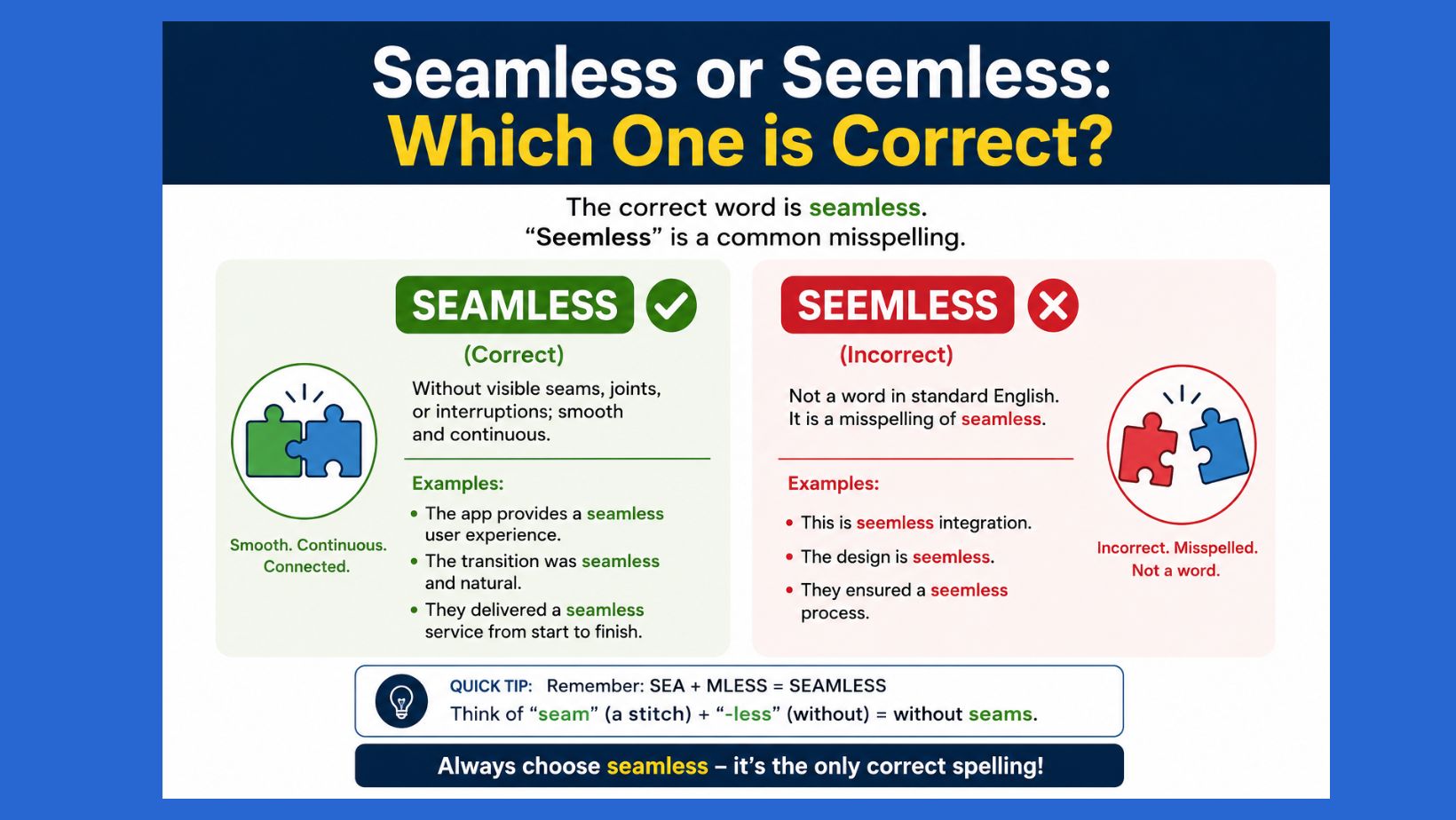

You typed a word and suddenly second-guessed yourself. Is it seamless or seemless?This is one of the most searched spelling questions in English grammar.
The short answer is simple. Only one of these words is real. The other is a misspelling. Keep reading and you will know exactly which one to use, and why.
Seamless or seemless: the quick answer
Seamless is the correct spelling. It is a real English word with a clear definition. Seemless is not a real word. It does not appear in any standard dictionary. It is simply a common misspelling of seamless.
If you write seemless in a blog post, an email, or a report, it is a spelling error. Replace it with seamless every time.
What does seamless mean?
Seamless is an adjective. It describes something done or made without any visible joins, gaps, or interruptions. The word feels smooth, clean, and unbroken — just like its definition.
The word has been in the English language since the 15th century. Its root is simple: seam (a line where two pieces join) + the suffix -less (without). So seamless literally means without seams.
Over the centuries, the word grew beyond clothing. Today, it covers communication, transitions, processes, and experiences. A smooth job interview, a clean software update, a well-written paragraph — all can be seamless.
Seamless in clothing and fashion
The clothing industry uses this word every day. Seamless garments are made in one continuous knitting process. There are no cut edges, no sewn seams, no pressure points on the skin.
This makes them more comfortable and better-fitting. Most activewear, sports bras, and base layers are designed this way. The goal is a smooth silhouette under tight clothing.
Common examples in clothing:
Seamless leggings — no visible stitch lines
Seamless underwear — no show through outer clothing
Seamless socks — no toe seam, better for sensitive skin
Seamless bras — smoother look under fitted tops
Seamless in communication and everyday writing
Outside fashion, seamless describes how smoothly something flows. A conversation with no awkward pauses is seamless. A plan that moves from one step to the next without confusion is seamless.
Writers use this word to describe transitions between paragraphs, ideas, or scenes. Teachers call a well-run classroom seamless. Project managers say a product launch went seamless when nothing fell apart.
The word carries a positive tone. It always signals skill, care, and smooth execution.
Seamless in a sentence: 5 clear examples
The tailor created a seamless jacket with no visible stitching.
Their customer service was seamless from start to finish.
She wore seamless leggings to the gym for extra comfort.
The transition between chapters was seamless and easy to follow.
His speech was seamless — every point connected to the last
Reference: Merriam-Webster defines seamless as “having no seams” or “having no awkward transitions.” (merriam-webster.com)
What does seemless mean?
Seemless is not a word. It has no definition. It does not appear in Merriam-Webster, Oxford English Dictionary, or Cambridge Dictionary. It is a phonetic misspelling that people write when they mean seamless.
The confusion happens because “seam” and “seem” sound similar when spoken quickly. But they have different spellings and completely different meanings. Seem means to appear or look like something. Seam refers to a line where two things are joined.
So seamless (without seams) becomes seemless (not a word) through a simple phonetic error. Now that you know the difference, you will never mix them up again.
Seemless in a sentence: showing the mistake
These are examples of incorrect usage. They show what NOT to write:
Incorrect: Her dress looked seemless and elegant. ✗
Incorrect: The presentation was seemless throughout. ✗
Incorrect: I bought seemless socks for my workout. ✗
In all three sentences above, the correct word is seamless. There is no context where seemless is the right choice.
Seamless vs seemless: side-by-side comparison
Use this table to see the difference at a glance.
| Feature | Seamless | Seemless | Verdict |
| Correct spelling? | Yes | No | Use seamless |
| In the dictionary? | Yes | No | Seamless only |
| Part of speech | Adjective | N/A | Adjective |
| Used in clothing? | Yes | No | Seamless |
| Used in writing? | Yes | No | Seamless |
| Word origin | 15th century | None | Old English |
The table makes it clear. Seemless fails every category. There is nothing to debate here. Seamless is the only correct choice in all contexts.
How to use seamless correctly in writing
Using seamless well means knowing when it fits and when it feels forced. The word works best when describing smooth, uninterrupted quality. Overusing it makes your writing feel repetitive.
Here are the main contexts where seamless works well:
Formal writing — a seamless integration of data sources
Product descriptions — seamless fabric technology
Business communication — a seamless customer experience
Academic writing — a seamless argument from premise to conclusion
Creative writing — a seamless shift from day to night
Avoid using seamless as a filler adjective. Do not write “it was a seamless event” unless you can explain what made it smooth. Be specific. Strong writing uses the word to mean something concrete.
Some natural synonyms you can rotate with seamless:
Smooth — works for transitions and processes
Continuous — works for physical or logical flows
Uninterrupted — stronger in formal or technical writing
Effortless — better when describing skill or ease
Polished — works for finished products or performances
Frequently asked questions
Is seemless a real word?
No. Seemless is not a real word. It does not appear in any standard dictionary. It is a misspelling of seamless. Always use seamless instead.
What is the difference between seamless and seamlessly?
Seamless is an adjective. It describes a noun. Example: a seamless design. Seamlessly is an adverb. It describes a verb or an adjective. Example: the plan worked seamlessly. Both are correct words. Use the one that fits your sentence structure.
Can seamless describe a person or a conversation?
Yes. Seamless can describe a person’s communication style, a conversation, or a presentation. A person who speaks clearly without any pauses or confusion can be described as seamless. The same applies to interviews, pitches, and public speaking.
How do you spell seamless correctly every time?
Remember the root word: seam. A seam is a line where two pieces of fabric meet. Seamless means without seams. Think of a shirt with no stitching lines. Spell it s-e-a-m-l-e-s-s. The vowel pattern is ea, not ee.
The bottom line
Seamless is the correct word. Seemless does not exist in the English language. Use seamless when you mean something smooth, continuous, or free of visible joins — whether you are writing about clothing, communication, or any kind of clean execution.
Check your draft before you publish. If you typed seemless anywhere, change it to seamless. That single fix will make your writing more credible and more professional.
